Showing posts with label book review. Show all posts

Monday, July 9, 2012

Book Review: Tahrekh ki Daryaaft

Discovering History by
Dr. Mubarak Ali
Publisher: Dost Publishers
ISBN: 978-969-496-352-5


Tahreek ki Daryaaft (Discovering History) is a collection of several essays written by Dr. Mubarak Ali. The book is divided into two parts.

The first part discusses different methods of interpreting history in the twentieth century. It also discusses the concept of hero worship; how heroes are created, and once they are used up, how they are metamorphosed or put down by the state. It also discussed the significance of historiography in Urdu language. It discusses about different translations done in this language, and how Urdu historians have interpreted history in different eras in the sub-continent.

The second part covers a broader subject area. It discusses about different aspects of Mughal rule, the relationship between Ottomans and Mughals, robes in Mughal court, White Mughal of Delhi, Akbar the Great. Besides, it also discusses history of basic goods like coal and coffee. The author also presents a short essay on The History of Smile. There are essays on imperialism and its affects, the role of clergy, tragedy of Indian Muslims, Indus civilization to more Sindh, and also an essay on the French Revolution.

The primary purpose of the book is to present new perspectives on history. Hence, Dr. Ali reviews more than three dozen books and some research papers. The purpose is to bring history to the commoners. It tries to explain how diverse the subject of history has become in our modern age. Today history doesn't mean only memoirs, diaries, scared literature, and King's speech. The subject of history also incorporates sociology, psychology, paleontology, and empiricism. Historians today also interpret history as a class struggle. Some deliberately view it with a prejudice, for example, European historians rectify Indian colonization because they thought the only civilized race is the European race, it is the duty of the Europeans to teach civility to the world. This is the interpretation of history from a European point of view. Likewise, in India, we see different religious prejudice in writing history. There are different interpretations available on Mughal rule in India, based on who is writing it down. 

The writing style is informative and lucid. The author has consciously kept the language as easy as possible; otherwise there is a tendency in Pakistan intellectuals to make thinks look more difficult than they really are. Furthermore, as the book is a collection of essays, it is readable for academia and students alike. It's not like an ordinary history book that goes on for infinite, making the subject of history boring and a waste of time. Each essay an average is four to five pages long, but very comprehensible.

Meanwhile, the book neither has a bibliography nor an end Index. This makes referencing to a specific topic difficult. As the book is mainly a collection of criticism and appreciation of different historical work, a bibliography was a necessary requirement.  

Thursday, June 28, 2012

Book Review: The Battle for God


The Battle for GodThe Battle for God by Karen Armstrong
My rating: 4 of 5 stars
Publisher: Ballantine Books

Price: Rs/= 1150
Pages: 442


In The Battle for God, Karen Armstrong traces the history of fundamentalism in the three monotheistic religions, i.e. Judaism, Christianity, and Islam. The author explains fundamentalism to be a modern phenomenon, which could only take place in our modern times. It is only in the post twenty century world that religion has been sent into the aisles while the values of liberalism control all aspects of human life. It is this attitude towards religion which allows the fundamentalist zeal to grow out of bounds. Fundamentalists consider themselves as the last saviours of religion; they have a mission to bring back religion from the aisles to the centre of our modern society.

Karen Armstrong gives a detailed account of different fundamentalist tendencies in the three faiths. She analyses the Heredims in Judaism, Protestant premillennialism in Christianity, and Syed Qutb's and Khomini's revolutions in Islam.

All these movements have transformed religious mythos into logos. In the pre-modern world, myths were never meant to be considered form a rational point of view. The inherent enigma present inside the mythos allowed people to connect with the divine. The logos, the practical aspects of religion, was always complemented these mythos. Therefore, a perfect balance between mythos and 'the practical' was always present. This balance was completely destroyed after the rise of scientific modern world. This new world was based on tangible and empirical evidences, with no room for mythos. Everything that was logo was open for a critical examination. As the fundamentalist cannot disregard mythos, they have tried to transform their respective religious mythos into concrete ideological logos. Be it the theory of Zionism, the idea of rapture, or the institution of Vilayat-e-Faqi. On the basic level, it is the transformation of mythos that has provided the much need energy to drive fundamentalism in the modern world.

Secondly, in today's world, Nihilism has become a basic ingredient of fundamentalist movements. They have created suicide bombers, excommunicated people who criticise their ideologies, and have put their back towards the modern world. It is these nihilistic tendencies which drives Jewish fundamentalist to plan an attack on the Dome of Rocks and Muslim fundamentalists, such as Taliban, to kill innocent men and women in the name of God. Nihilism has become an integral part of their program.

Meanwhile, the book also maintains that fundamentalism is primarily a modern movement. It is a reaction to the ethos of the modern world. In this respect, fundamentalism isn't an inherently religious movement. It has originated due to the internal dialectics of modern societies. Hence, it is the scientific drive which has led Christians and Muslims alike to test their sacred scriptures on the touchstone of modern science. Moreover, the alienation created as a result of the total neglect of mythos has clearly distorted our subconscious self. Humans always need mythos as much as they need logos. This alienation has created, in the words of Sartre, a "God-shaped hole" that needs to be filled up. Fundamentalism tries to fill this alienation problem, but mostly it is unsuccessful in performing this task.

The author has done an excellent job in trying to explain the fundamentalist's view point from their own perspective. Without understanding their believe structure, it is quite impossible to dialogue with them. Dealing with a fundamentalist is like dealing with an anachronistic person. A modernist and a fundamentalist can never understand each other points of view, because they don't exist on the same plane of thought.

The book prophetically claims hat fundamentalism is here to stay. Liberalism hasn't been able to solve all human problems on the basis of rationality. Fundamentalists of the three faiths will always exploit this fact for their personal agendas.

The aim of this seminal book was to present a historical analysis of Fundamentalism. The author has excellently done her job. She has elaborated all forms of fundamentalists tendencies which have arisen in these great faiths. The book is highly referenced and an excellent bibliography is presented at the end.

View all my reviews

Sunday, May 27, 2012

Book Review: Persian Idioms and Adages

Book Name: Farsi Zarb-ul-amsaal aur Khawatain
Compiler: Muzzamil Ahmed
Publisher: Ferozsons
Pages: 240
Price: 100 rupees 

Idioms and adages summarize the collective human conciousness of a culture, nation, cult or a race. Idioms hide behind themselves a history of events. Sometimes they signify accidents. Sometimes, regional adages hold a treasure chest of wisdom in a precise sentence.

In earlier times idioms lived on through oral transmission from one generation to another. Even stories used to be transmitted through this medium. Two pertinent examples are The Adventures of Ameer Hamza and The 1001 Arabian Nights. Both of these books were regional oral traditions, but over generations they have become bed-time stories for children and past-time stories for teenagers and adults. 


Even Prophet Solomon (peace be upon him) compiled a book called the 'Book of Wisdom' which is now a part of the Bible. The book contain a large collections of Adages for the human race.

Thinking on this thought, Muzzamil Ahmed has done an excellent job in compiling approx. 1,500 Persian idioms with urdu translations in a book form. The purpose of this book, as Muzzamil states, is to allow the common reader to understand Persian idioms which have become common in our daily life. 

I found that most of the idioms were masculine in nature. This signifies the fact that most of these sayings developed in a patriarchal society. Women had a very small role to play in this society. The word Mard (Man) is frequent in many proverbs.

Secondly, religion had a very important role in traditional societies. Words such as Yazdaa (God), Allah (God),  Daroog (vice), NAik (virtue), Yousuf (Prophet John (peace be upon him)), Mosa (Prophet Moses (peace be upon him)), et cetera are scattered all over the book.

Here are some idioms from the book:


Transliteration: Bar Zaban Tasbhi wa dar dil ghoo khar
Translation: God's name on the tongue, while the heart filled with thoughts of cow and donkey

Transliteration: Dar Hamaa Kar Mashwaray Bayad
Translation: Taking Advice is  necessary in every work

Transliteration: Ta kaay Ahmaq baqi ast andar Jahaa'n
Mard-e-Aqel  kay Shayad Motaj-e-Noon
Translation: Until the fool is alive, the clever will never sleep hungry

Transliteration: Zay Sad teer Ayad yakay bar Neshaan
Translation: A single arrow from a hundred hits the target

Transliteration: Saiyaad na har baar shikaar baburo
Translation: A hunter doesn't always find a prey


Saturday, May 19, 2012

Book Review: The Impact of Science on Society

The Impact of Science on Society is authored by Bertrand Russell - an eminent British philosopher who lived in the era of the World War II.

The Great War had a great affect on Russell's thought process, making him a vehement critic of war. He stood against the British policy of extending the war on Germany, and was sent to jail for speaking against the wind of his time.

When reading 'The Impact of Science on Society' it is necessary to understand that Russell is trying to create a more stable and sustainable world. For him, the only possible model for a stable society is that the whole world comes under a single government. He proposes United States to take this role. Russell writes:
"A scientific society can be stable given certain conditions are fulfilled. The first of these is a single government of the whole world, possessing a monopoly of armed forces and therefore able to enforce peace. The second condition is a general diffusion of happiness,.... The third condition (which supposes the second is fulfilled) is a low birth rate everywhere, ... The fourth condition is the provision for individual initiative both in work and play." — pg. 139
The First Condition
In modern times, the United Nations can be a substitute for Russell's idea of a single monolithic government. The mandate of UN should be increased allowing it greater interference in domestic policies. People might agitate on grounds of nationalism and patriotism, but in the end, the coming generation would simply forget how the world was conquered by a single power in the bygone days. It should be noted that people will only forget the 'love for their nation' if the second condition is fulfilled.

The Second Condition
Russell rightly says that it is only through 'the diffusion of happiness' a monolithic structure can acquire some legitimate grounds for setting up a workable mechanism. The vast majority of the people in the world believe in consequentialism - a doctrine in ethics which says that actions are either good or bad depending whether the output of those actions are good or bad. Therefore, if  teenagers in Karachi is able to acquire the same living standard as in any other parts of the world, they wouldn't even thing about the bygone age of their forefathers.

It is to be noted that past is mostly worshipped in societies where the future is dark and bleak. They worship past out of nostalgia. This nostalgia allows them to continue living, even in the most dire conditions possible. On the other hand, when the present is brighter than the past, people simply don't care what happened before. The past becomes unthinkable for many. The German diplomat recently commented:
"Before 1940s peace was unthinkable between Germany and France, but after 1950s war is unthinkable between Germany and France."
The collective 'diffusion of happiness' which the people of France and Germany have enjoyed can be replicated in other parts of the world.

The Third Condition
Population growth is the biggest problem of all. In the future, scientist and economists are going to call this the mother of all problems.
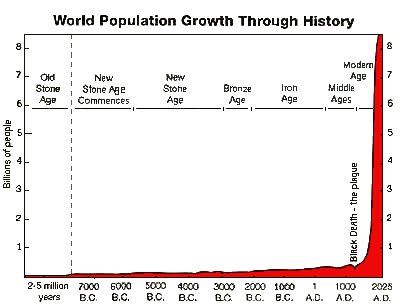
World Population Growth. Source: SUSPS

Just 9000 years ago the world population was near one million. In the last 250 year, i.e after the Industrial Revolution (1750 onwards), the world has experienced a population explosion. The graph becomes asymptotic as we approach 2025.

In such a situation,even maintaining nominal standard of living becomes a major problem. Just read today's  DAWN. The article clear states that Pakistan is going to face sever water shortages in the year 2025. It should be kept in mind that the Great Indus flows through the heartland of the country. If Pakistan is going to face a severe water shortage, the conditions in Africa are bound comprehension.

An exponential population growth with a gradual decrease in earth's resources signals that progress might becomes an unachievable goal for many. The oil is going to end at the turn of this century, the radioactive waste is going to be a major international debate issue in the coming decades. The lack of oil and free-space to dump radioactive waste on our plant, will pollute the Milky Way. That's the only place we can dispose off our waste. A decrease in population with a decrease in living standards is the only way forward to solve this anomaly.

Russell comments on population growth is really prophetic. Planers have to understand that an ever increasing population at such a rate is disastrous for the coming generations.

The Fourth Condition
For Russell, individuals have a big role in making the world more liveable. Even if we get a control on the  population accelerator, the world can only be a better place if everyone does more than his destined role. The will to change is an integral part in how Russell envisages a better tomorrow.

***

Russell also criticises the role of science which had made man into a living cog with no more usability that a machine which produces efficient output. Russell writes:
"What science has done is to increase the proportion of your life in which you are a cog, to the extent of endangering what is due to you as a hero or as a common man." — pg. 76
Russell says that it is the duty of the modern democracy to stop the ultimate conversion of man into machines.
"The idolatry of the machine is an abomination. The Machine as an object of adoration is the modern form of Satan, and its worship is modern diabolism" — pg. 77
In Russell's definition, a good society is characterised  by three qualities. 1) The man should be useful, 2) He should consider himself secure in times of misfortune and 3) He should have the opportunity for taking new initiatives, in all ways, not positively harmful to others.

Unfortunately, neither a capitalistic society nor a communist society can fulfil such a goal. Russell writes:
"Under capitalism. the incentive is fear of starvation; under communism, it is the fear of drastic police punishment. Neither is quite what the democratic socialist wants." — pg. 82
In this sense, Russell acts like a Pakistan Molawi Shaib or Allama Iqbal. They too vehemently criticise European ideas, but are unable to formulate a new theory out of their own meta-physics. Russell has the benefit of being a European, hence his criticism is on his own meta-physics rather than an alien meta-physics.

Science, for Russell, has become a tool for changing the conception of the world (pg. 98). The materialist world around us is a miracle of science. Nowadays, empiricism has become a touch-stone for identifying truths. A 100 years ago, no one would have heard about DNA being used as a tool for identifying the real parents of a baby. Centuries ago, there were strong tribal and family structures. Family identification was never a problem in these bygone societies. The DNA verification technique has allowed us to view the world through a totally different perspective. Now, it is not just through strict family hierarchies that a court might order a decision on a birth identification issue, the DNA report (simply a cluster of some amino acids) also holds the same validity as that of family hierarchies. This is how science has changed our conception of this world.

Russell also mentions the limits of science. Although, if he was living today he might have amended the following sentence:
"Science, while is has enormously accelerated outward change, has not yet found anyway of hastening psychological change, especially where the unconscious and sub-concious are concerned" — pg 134

Friday, April 20, 2012

Book Review: Tahzeeb ki Kahani

Tahzeeb Ki Kahani  by Dr. Mubark Ali
Tahzeeb ki Kahani is a history of civilization written by Dr. Mubark  Ali - an eminent historian and a RUHR Ph.D.

The book is in Urdu and contains many pictures illustrating the different phases of civilizational progress. The history starts from early Stone Age and ends up at Iron Age.

The book answers many questions. For example, Why do men and women wear cloths? When did men started to cultivate and why? How has fire changed the framework of human life? Why did the Indus civilization met a downfall? The book also covers the  rise and fall of Roman civilization.

The ancient city of Mesopotamia is also visited by the author. The architecture, and the administrative division in this ancient world allowed human to survive all along the ages.

The book discusses about the great Persian king Koresh. Koresh was a great figure in the ancient world. He changed the perspective of how a ruler should rule. The document presented by Koresh can be called the First Deceleration of Human Rights. Koresh, although a Persian king, ruled over the Arabian people. He never tried to forcefully implement Persian language over the conquered. This makes him a peculiar man in ancient history.

The Indus valley civilization is a peculiar civilization in ancient history. Historical digging sites reveal interesting information about the lifestyle of this civilization. No big temples are found nor are religious structures in abundance. Neither are mansions excavated from the digging sites. No murder is reported in the criminal records of the civilization. With all these traits the civilization triumphed from 2600 BC to 1900 BC. Historical records are spread out from Mehar Gahr, Balochistan to Rajaistan in India. This shows that wars aren't necessary for a civilization to survive. Neither is a centralized king necessary nor any Authoritarian federal system. Records also provide evidence for existence of trade between Mesopotamia and Indus Valley Civilization.

The Egyptian civilization is also discussed by Dr. Mubark. A new perspective is elucidated on the Egyptian pyramids. Rather than seeing these structures as marvels of human architecture, we should see them as an epitome of forced labour. Thousands of men, women, and children were killed during the construction of the pyramids. Slaves were forced to death through starvation, and no stipends were given for the construction of the pyramids. The priest had a central role in the Egyptian civilization. Pharaohs used to take their advices on important matter. Hence, it can be said that the Egyptian system of government wasn't secular as the Indus Valley. The priest also had a central role in the burial ceremony of the Pharaohs. It was only the priest who knew the exact position of a Pharaoh's grave as only he was allowed to return back once the burial ceremony ended. All slaves were killed by his holy decree. The killing of slaves fulfilled two purposes:

  1. It allowed the grave to remain a secret. As gold and silver was buried with the Pharaoh, secrecy was kept so that no thief could steal it.
  2. According to Egyptian religious order, the slaves who are buried with the Pharaoh would remain his slaves even in the after-life. Hence, this killed would allow Pharaoh to have slaves even in the world hereafter.
The rise of Roman civilization is attributed to the use of iron. The Romans were able to set up a senate, which was a quasi-democratic system. The story of Remulus and Remus is an interesting read. It is the oldest piece of world literature and a story of love which is beautifully summarized by Dr. Mubarak Ali.

The Greek and Chinese civilization are also discussed. Many inventions are attributed to Chinese, e.g. paper, compass, and ship construction. Unfortunately, the civilization remained a closed civilization for many centuries. Confucius was an eminent figure in Chinese civilization. He introduced civil examination system for the first time in history. Confucius has the same stature in Chinese civilization as St. Augustine in Christian Civilization. 
                      On the other hand, democracy is a system developed by Greek world. Socrates, Plato and Aristotle are the great men of this civilization. 

To sum up, Tahzeeb Ki Kahani  is an excellent book for anyone who interest in history. It contains intriguing details and summarizes the evolution of civilization over time. One message which the book give oft-repeatedly is that humans have always opted for progress when given a choice between progress and regression. In this sense, we can always hope for a better tomorrow.