
 |
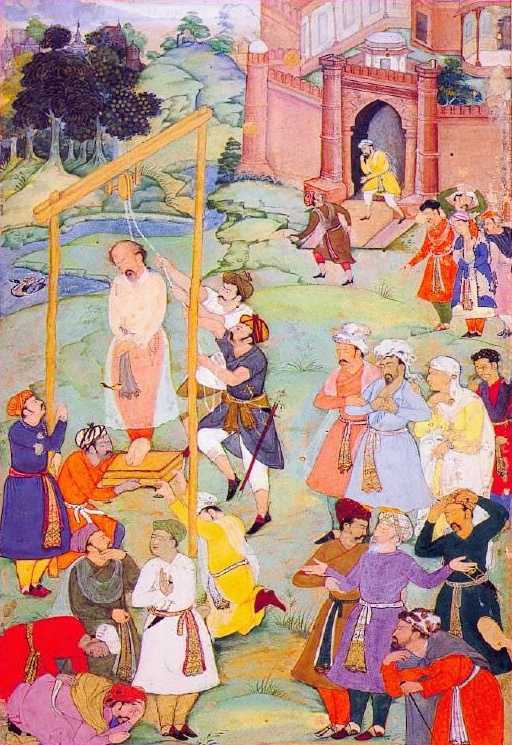
| Mansur being hanged. Source: Wikipedia.com |
This post is dedicated to
the unknown vagabond who was killed by a frenzied mob in Bahawulpur.
Hussain Mansur Al-Hallaj (c. 858 – 26 March 922) is a charismatic personality in Sufism. His mantra 'An'al Haqq' (I'm the truth) has been a topic of discussion inside the Muslim world for centuries. Orthodoxy view his statement in the realm of infidelity while mystics regard it as the epitome of love for divinity. For the revolutionists, Mansur provides the necessary impetus to die for the truth. For the Sufi and saints, Mansur is an occult, an abstraction which cannot be comprehended by our finite minds. Iqbal, the 20th century poet-philosopher, wrote for Mansur:
کم نگاهان فتنهها انگیختند
بنده حق را بدار آویختند
آشکارا بر تو پنهان وجود
بازگو آخر گناه تو چه بود؟
بنده حق را بدار آویختند
آشکارا بر تو پنهان وجود
بازگو آخر گناه تو چه بود؟
The Bigots incited the seditions
(and) took the Noble to the gallows.
On you were the secrets of existence disclosed
(can you) again speak what your sin really was?
The event of Mansur's execution is narrated by Ata'r Nishapuri in his book Tazkarai Oliya (Saints' Biography). The Wikipedia's Persian has added details mentioned by Ata'r Nishapuri. Unfortunately, this historical event isn't present on the site's English page. My translation is as follows:

It is said that, a vagabond (present in the crowd) asked him, "what is Ishq (Love)?".
He replied, " Your today, tomorrow and day after tomorrow resides with it. On its first day, it kills, next it burns, and on the third day it goes with the wind; hence this is Ishq."
While standing on the gallows, Mansur's servant asked him his final will. He said, "Keep your soul busy in things you liked doing, if you don't do this, it will keep you busy in thing you don't like doing. Herein, work itself becomes the work of a saint." Hence, the way he choose for himself was the path towards personal satisfaction....
They asked, "What it the way towards personal satisfaction?"
He replied, "Under my gallows." Because the door under the gallows took him to the scaffold, and his feet were on it's ladder [Mansur's personal statisfaction was to die in God's way].
They asked, "What is self?"
He replied, "It is the ascension of the leader."
Then, a turban man with a shawl on his shoulders came in. He raised his hands and prayed. He said, "What he knows, nobody knows."
Then, Mansur was hanged.
Everyone threw stones on him, Shibli was successful in throwing a flower. Hussain Mansur sobbed in pain and said, "I haven't cried out due to the stone, but due to the flower". Why should pain be expressed?
He said, "Many of them don't know (why they are throwing stones), they are uninformed. But I felt the pain of the flower as he knows that it mustn't be thrown".
Then they cut off his hand; He laughed. They asked, "Why are you laughing?".
He said, "It is easy to cut arms of a stranded person. Man is he who cuts off that hand which gains it attributes from the apex of the universe."
Then, his legs were amputated; He laughed and said, "Without human legs I had travelled into the other worlds, in which I can still travel. Can you amputate those feet (which allow me in travelling into other world)!
Then he rubbed his blood pouring out through his two amputated hands until both of his forearms and his face were red in blood. They asked, "What are you doing?"
He said, "Much blood has poured out, I know my face has turned yellow. You may think my face has turned yellow due to fear. I'm splattering my face with blood so I could look red in your eyes, because men recognize their blood.
They said, "If you wanted to turn your face red, why did you rubbed your forearm with blood?"
He replied, "I'm doing ablution (Wa'zu)."
They asked, "What ablution!"
He said, "In love there is a two rakat prayer. You cannot perform the ablution for this prayer without blood."
Then his eyes were taken out. The crowd roared, some cried and some threw stones. Then they wanted to take out his tongue.
He said, "Why are you waiting for me to speak?", he directed his face towards the sky and said, "O Lord! What they are doing with me is for you, don't keep them deprived from reward (which they think they'll get on the Last Day). All praise be to the Lord! My hands and feet were amputated in your path. If my head is truncated from my body, they'll see your glory on the gallows".
Then his eyes and ears were amputated, while stoning continued. An ugly woman came with a bowl. As he saw Hussain, she said, "Beat him! Beat him until this little Hallaj knows who God is".
Hussain's last words were, "Hubul Wahid Afraadul Wahid [Arabic]".
Then his tongue was amputated, and at time for evening prayers, his head was amputated. His face had a smile and was lively. Our people had clamoured (for his death), but ironically, in the end Hussain was taken to Maydaan Raza.
***
A beautiful poem on Mansur Al-Hallaj. Are Logo tumhara kiya (Why are you worried):
Reference:
[1] Persian text available at: Mansur Al-Hallaj. Translated from پس حسین را ببردند تا بر دار کنند. صد هزار آدمی گرد آمدند to سرش ببریدند و در میان سربریدن تبسمی کرد و جان بداد و مردمان خروش کردند و حسین گوی قضا به پایان میدان رضا بردند.


